Links
Figure: Cumulative type I error (Ville error) and rejection times for proposed e-processes and for classical, non-sequential baselines, SD null vs. non-SD alternative
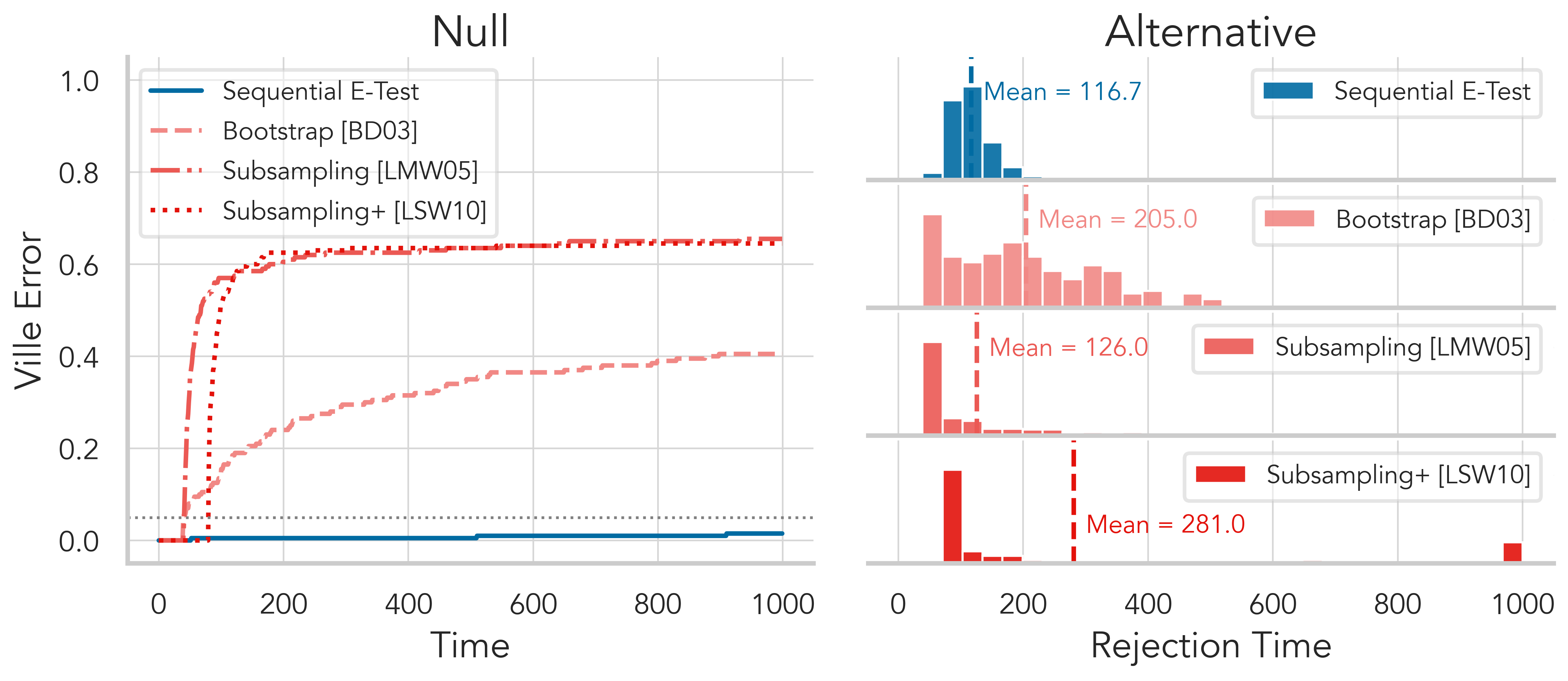
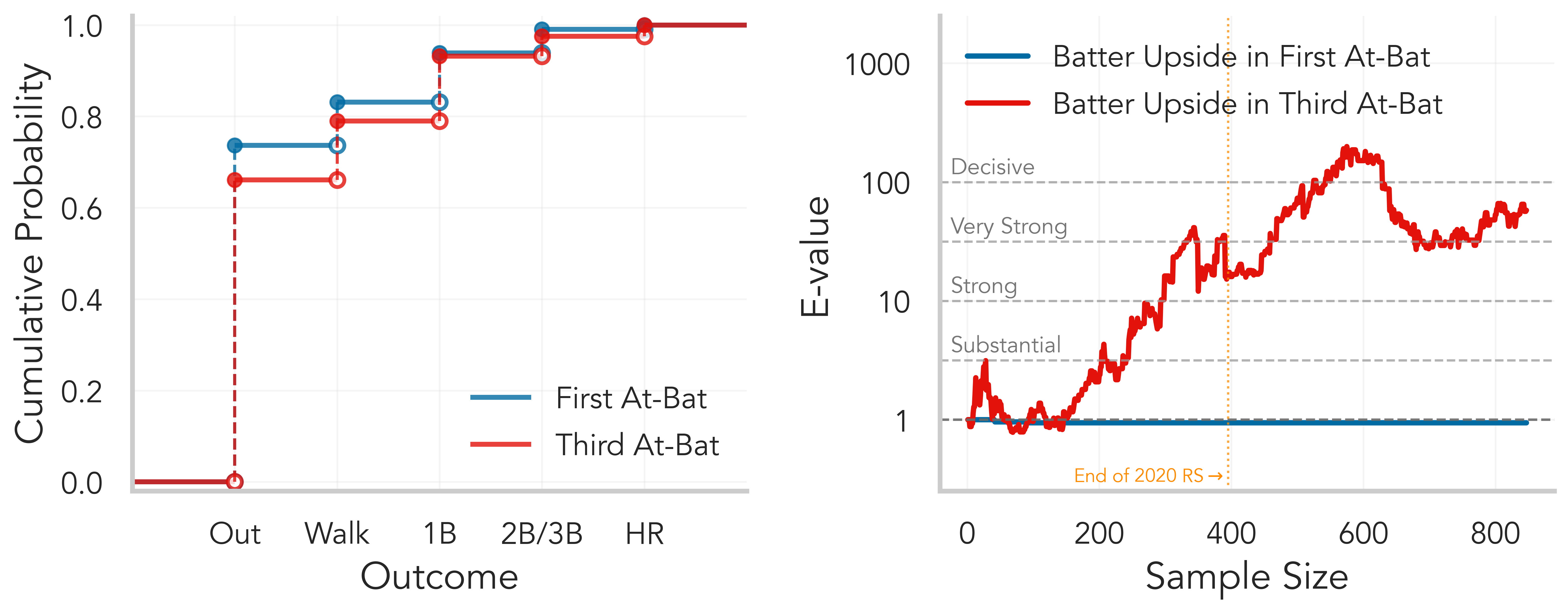
Figure: Comparing pitcher performance in first vs. third time-through-the-order in Major League Baseball (Blake Snell, 2016-2025)
Abstract
How can we monitor, in real time, whether one uncertain prospect has any upside over another? To answer this question, we develop a novel family of sequential, anytime-valid tests for stochastic dominance (SD), a classical and popular notion for comparing entire distribution functions. The problem is distinct from that of testing mean dominance, and it is particularly useful when comparing distributions with similar means or with ordinal outcomes. We first derive powerful, nonparametric e-processes that quantify evidence against the null hypothesis that one prospect is stochastically dominated by another. For first-order SD, these e-processes are based on mixtures of growth-rate optimal e-variables, yielding a test of power one that retains validity under continuous monitoring. We then generalize the approach to sequential testing for higher-order SD and other integral stochastic orders. Empirically, we find that the tests are competitive in power with classical, non-anytime-valid SD tests. Our real-world application examines a controversial phenomenon in baseball analytics, known as the “third-time-through-the-order (3TTO) penalty,” viewed as a monitoring problem. We close by sketching the complementary problem of testing whether a prospect has a definite upside, formalizing conditions under which we can derive a powerful anytime-valid test.
Citation
Arnold*, S., Choe*, Y. J., Scarsini, M., & Tsetlin, I. (2026). Betting on Bets: Anytime-Valid Tests for Stochastic Dominance. arXiv preprint arXiv:2604.21851.
@article{arnold2026betting,
  title={Betting on Bets: Anytime-Valid Tests for Stochastic Dominance},
  author={Arnold, Sebastian and Choe, Yo Joong and Scarsini, Marco and Tsetlin, Ilia},
  journal={arXiv preprint arXiv:2604.21851},
  year={2026}
}